

I’ve been spending quite a bit more time lately thinking about the nature of firms, incentive structures, and more given the rapid progress in model capability.
I wrote this piece several months ago but never got around to publishing it. I’ve since revised it to reflect recent developments, and I hope it provides useful context for future pieces about how the nature of the firm is changing.

Several months ago, Long Lake agreed to acquire Amex GBT, a corporate travel platform, at a price of $6.3 billion. The deal structure itself was incredibly interesting, involving a mega-syndicate of capital partners and beating out several large PE firms for the deal at the last minute.
This was the first time Long Lake showed up on the radar for many people. Make no mistake though, they’ve been incredibly active in the M&A markets and have a team chock-full of killers across technology and dealmaking.
Their initial HOA management business is now one of the largest in the US and a number of their other theses are beginning to scale.
The AI-Native Acquirer
The Long Lake Acquisition Thesis in a nutshell:
Get to scale as fast as possible or (now) obtain an asset with vast scale
Aim for assets that have distributional moats that are not reducible to LLM costs
From there, the acquisitions are at sufficient scale to realize huge automation improvements via plugging AI into the mix. Long Lake in particular believes that these automation benefits can materially improve revenues, customer satisfaction, and growth without having to fire people inside the businesses.
In a nutshell, there are two things Long Lake does particularly well:
They’re equipped to come in with rapid capital from a pseudo-sponsorship/syndicate model.
They have the FDE/AI talent to underwrite and perform transformation.
Largely, you can index Long Lake as one of the first firms built around the AI trade, which I would frame as the following:
The next 10-15 years involve more special situations than ever for capital allocators to take advantage of as there is talent scarcity around executing AI transformations to realize the full potential of so many businesses. AI increases winner-take-all dynamics in many markets and as such, buying these special situations capable of extended market dominance with enhanced AI capability creates durable, growing assets.
If you don’t believe me, look at the resources that Anthropic and OpenAI are pouring into deployment companies as model progress is now bottlenecked by sociotechnical problems and skill issues even in the face of ever more powerful models.
And so, we are seeing the rise of neo-acquirers that are doing a couple of things at once:
They underwrite deals differently, steeped in model-capability trends, private evaluations and proprietary operating data.
They’re deploying talent into these companies to execute the transformation.
Turning companies into AI-enabled services is quite difficult and involves a skill set totally novel to traditional management. How do you do the requisite data normalization, structuring of workflows, evaluation of agents, org chart restructuring, systems integration, and more that is required?
Most AI tools are bottom-up productivity tools. They allow individuals to achieve higher productivity gains that the firm itself never sees. Instead, AI continues to be a sociotechnical and top-down management problem. To transform a firm, you need a mandate to do so.
And so naturally, the Coasean bargain will ensue and these special situations will crop up at increasing rates as companies transfer into nimbler hands that can do the hard work of deployment.
Many traditional private equity firms still don’t fully get this. AI is seen as an efficiency lever and not as a foundational transformation. But that too is changing, in part as extremely capable dealmakers leave firms to forgo the partner track and strike out in one of the friendliest periods for independent sponsors.
Given the curiosity in the market today around how to underwrite these transformations, I wanted to give a brief sketch around the underwriting that’s happening through the lens of Amex GBT.
This is not exhaustive and is narrowly scoped and simplified around the AI logic involved in underwriting these businesses, but I hope it’s useful.
The High Level:
Amex GBT has more than 27,000 employees operating across 49 countries.
Amex GBT has approximately 12,000 traveler care/ops professionals
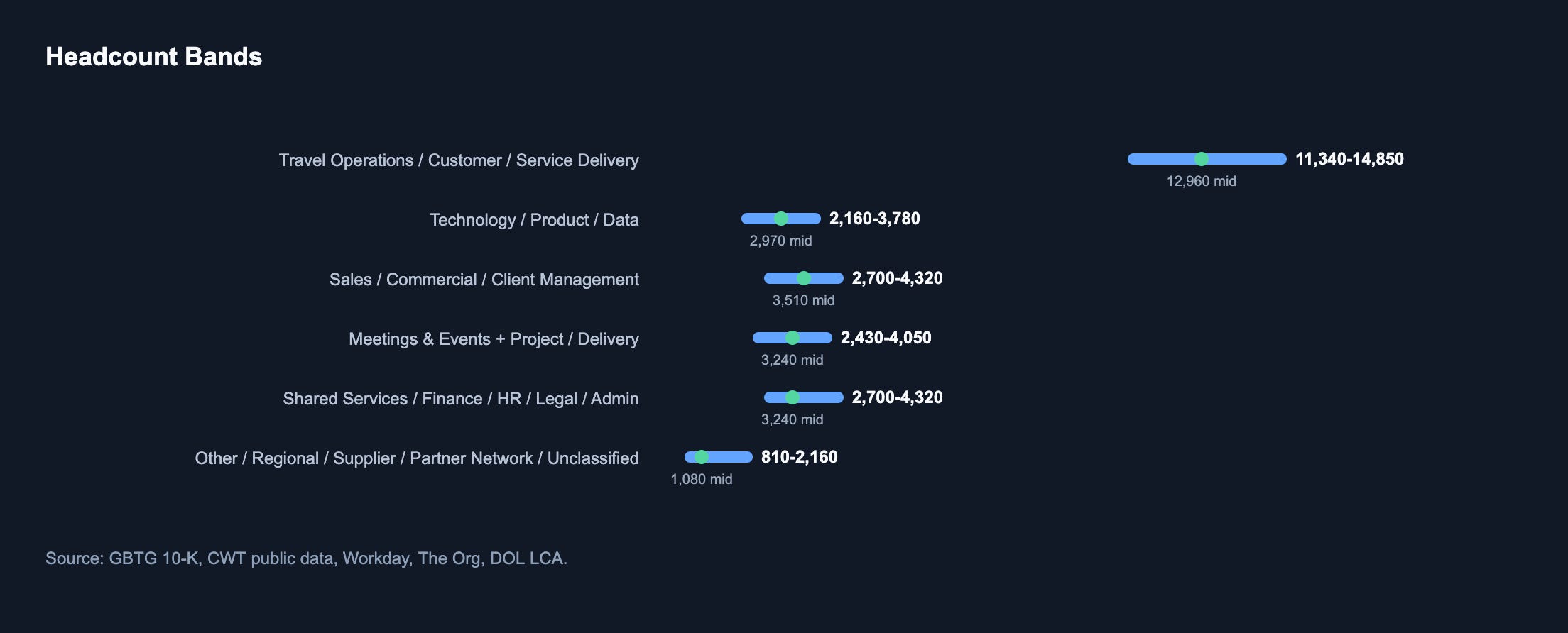
Amex GBT handles roughly 17 million phone calls and 20 million emails annually. This gets you to about .74 customer interactions per travel transaction.
In brief, the transformation case rests on creating better platform products that corporates want to use to book travel and reducing the customer interactions per transaction.
Two questions follow:
Does Amex GBT possess data that gives them a definitive advantage in enhancing the corporate travel space via AI?
Are models increasingly showing capability gains on the work?
Let’s cut to the chase: the answer is yes to both.
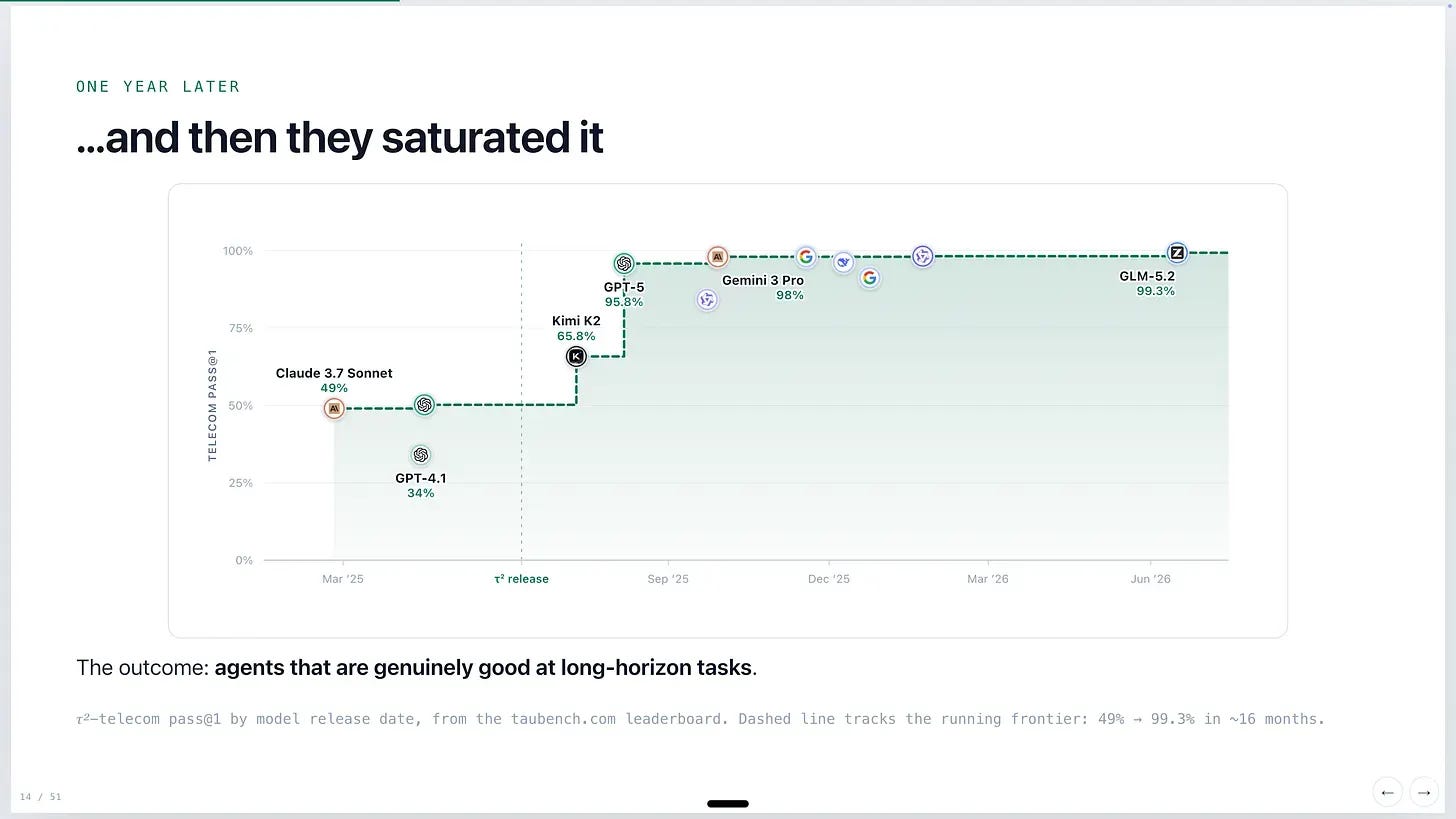
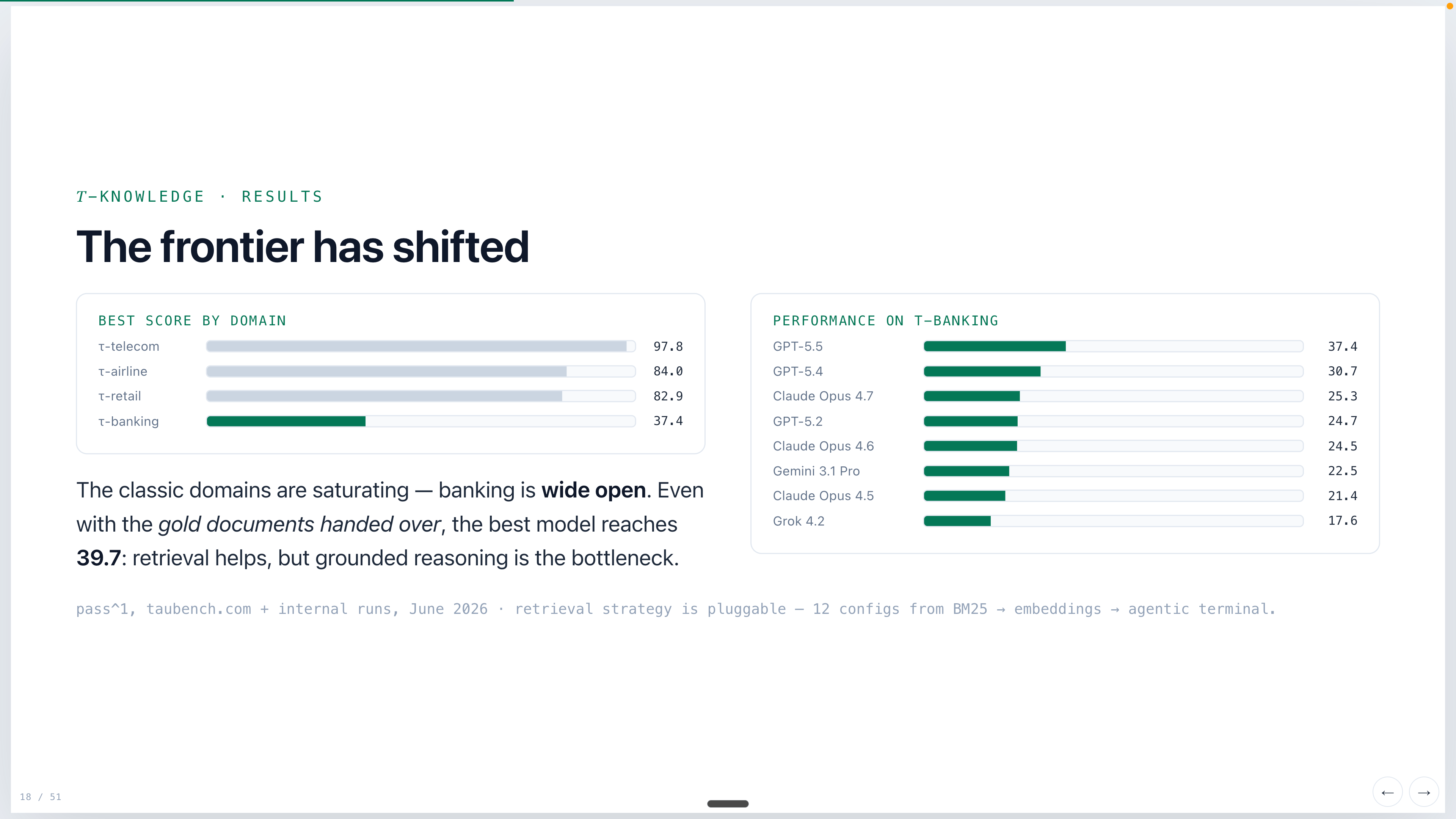
Already public evals indicate that for travel booking, we are in the range of plausibly automating a vast array of the customer service operations. In fact, we can’t come up with benchmarks quickly enough that don’t get totally saturated. This gets us in the range of automation, from here, Long Lake’s bet is going to be on specifically automating large parts of the supporting functions around travel.
The Real Asset is the Trace
Amex GBT did 50m+ travel transactions last year with about .74 customer interactions per travel booking. By channel, it’s safe to assume that the high complexity stuff and random travel scenarios ( last minute flight cancellation, etc.) are going to form a large percentage of the operations cost. To automate these and subsequently headcount plan, you really need a data set that you can leverage to form even more granular evals. Turns out that’s another great reason to buy Amex GBT.
The data asset value here is easily worth tens if not hundreds of millions given data acquisition trends from labs. Edge cases in agent scenarios are at a premium. Every model capability gain from the labs enhances the value of those who can evaluate and use models on edge cases. And ultimately, post-training models depends on vast amounts of edge cases.1
Critical to the entire thesis here in my opinion is the huge backlog of data that Amex GBT possesses across every single travel scenario. They have hundreds of millions of data points, call logs, emails, compliance decisions, hotel, airline info, and more. Long Lake will quickly look to turn this data into a set of evals and judge model performance on each customer segment.
Travel solutions work via translating travel intent, corporate policies, and more into a set of correct API calls or button clicks in a GDS system. They subsequently work via offering support for when travel changes or hiccups like a flight change occur.
In order to develop conviction on the specific actions that you are willing to enable agents to fully take over vs. merely augment human decisioning, you need a rich distribution of data to reason over complete with full interaction logs.
This forms a data corpus that then can be used to continuously assess model performance (evaluate) and/or train models. It’s a dataset that is likely the richest in the world and as a result, there’s a colorable argument that Long Lake bought the dataset and distribution, rather than the operations.
My guess is Long Lake made a determination during due diligence around a scoped set of data provided by Amex GBT and found highly promising results for nearly every travel segment around model progress. If they didn’t, their team absolutely made the call from synthetic data on the value here.
Increasingly neo-acquirers are going to make these model capability to company operations evaluations during underwriting. Meaning that as AI becomes a larger part of the underwriting case, the requests for example data traces in due diligence are going to pick up. More than ever AI deployment companies, PE, and more need emblematic traces in a vertical in order to make these decisions and form diligence hypotheses. The smartest acquirers will continually prize data assets for transformation and evals during diligence in order to discover mispriced opportunities.2
With this acquisition, I don’t think you have to posit anything drastic to conclude that you can immediately create more incremental margin per transaction by having AI agents handle more and more of the customer interaction layer.
The Underwriting Math
What is the natural limit on customer interactions with humans per transaction over a 10-year period?
A lower interaction rate doesn’t flow through to EBITDA without either a) org reconfiguration or b) more revenue.
If Long Lake cuts the current ratio of customer interactions per transaction in half without reducing headcount, Amex GBT would need to double transaction volume. Over five years, that requires nearly 15% annual transaction growth and taking revenue from approximately $2.7 billion to $5.4 billion. That’s far above Amex GBT’s historical growth patterns.
To preserve employment while reducing service interactions, Long Lake would need to redirect some of the released capacity toward building and delivering higher-value products and services. Perhaps the most interesting part is the increased attach rates that can be commanded via selling better corporate-travel management platforms with AI-agent facilitation.
How much does speed matter during a travel disruption? In my experience, it is invaluable. Agents operate much faster than traditional service channels, and corporate customers will pay for that responsiveness. Can Amex GBT attach additional software revenue while retaining its transaction-based economics and lowering the cost to serve? Not only does it look possible; it looks likely.
At $6.3 billion, Long Lake is paying approximately 11.8x adjusted EBITDA. That price begins to look cheap if Long Lake can jumpstart revenue growth with substantially higher incremental margins. Given the brand association with Amex and distributional moats as they figure this out, it looks plausible.
Transformation begets transformation, deployment begets deployment.
But make no mistake, it still requires talent. And that talent is at a massive premium right now. The skill set required to navigate change management, deployment, model capability advisory, and more is incredibly scarce.
But as the market shifts and the very nature of firms shifts with it, perhaps that in turn is the opportunity.
And remember, today is the worst the models will ever be.
My guess is they don’t do this anytime soon, but it remains a possibility. Post-training in the face of rapid base model capability growth can become a fool’s errand.
Within the next nine months, I expect private-market investors to begin acquiring datasets specifically to construct proprietary evaluations of economically valuable model capabilities for use during deal underwriting.
excellent analysis - well laid thesis out and use case. It’s not just about productivity gains…The data + AI will be the fuel for segment transformation and growth.